
CVD vs HPHT Lab Diamonds: What Singapore Buyers Should Know
Lab grown diamonds are produced by two distinct processes — CVD (Chemical Vapour Deposition) and HPHT (High Pressure High Temperature). Both produce real diamonds. Both are graded on the same 4Cs scale by the same laboratories. But they differ in how they are grown, what characteristics they tend to produce, and what to look for when evaluating a specific stone.
At Diamond Ateliers, we source lab grown diamonds for bespoke commissions every week. This guide explains the practical differences between CVD and HPHT in clear terms — not to push you toward one or the other, but so you can ask the right questions and understand what you are looking at.
How HPHT Diamonds Are Grown
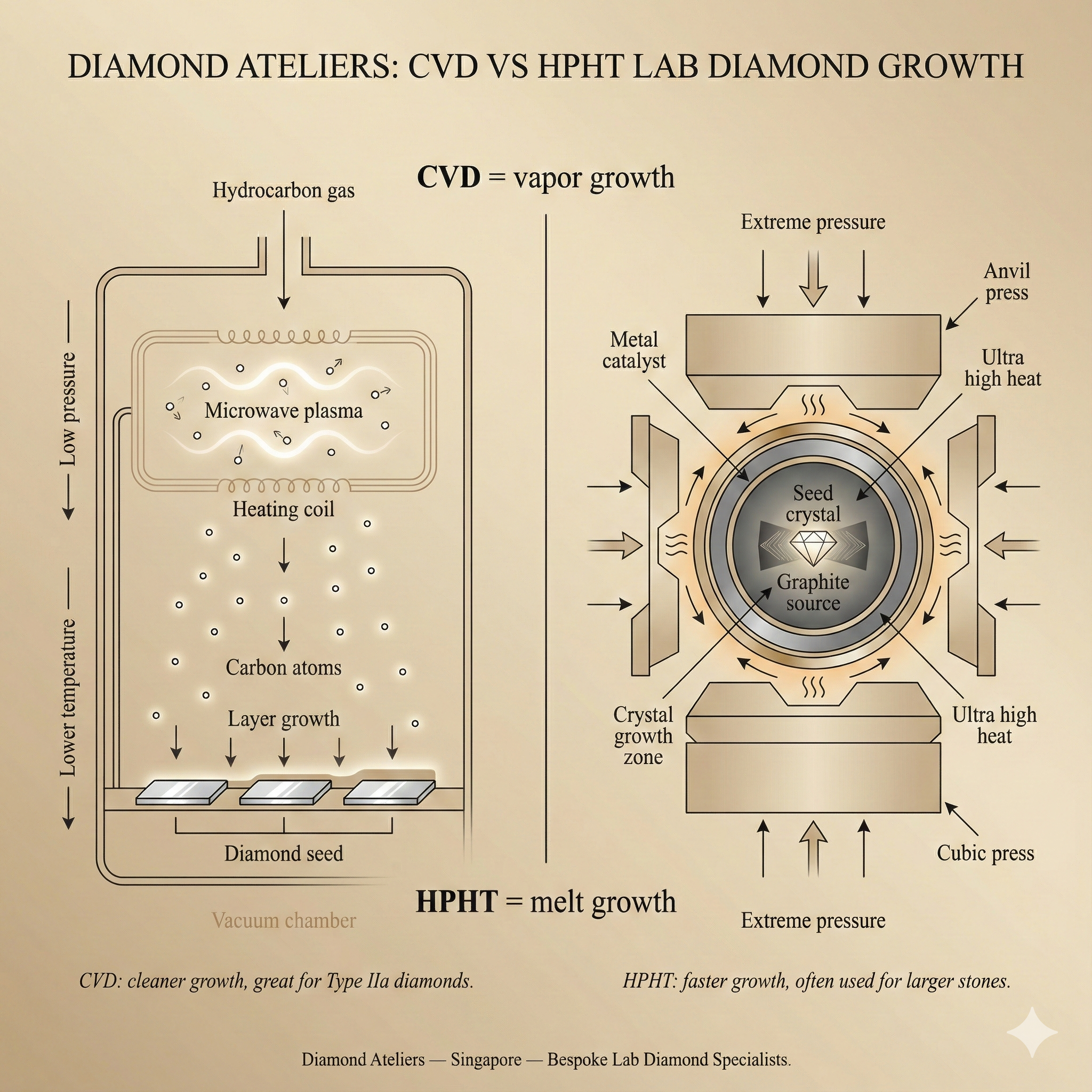
HPHT replicates the conditions deep within the earth — extreme heat and pressure — to grow a diamond from a carbon seed. A small diamond seed is placed in a growth chamber with a carbon source and a metal catalyst (typically iron, nickel, or cobalt). Under temperatures of 1,300–1,600°C and pressures of 5–6 GPa, carbon dissolves into the molten catalyst and crystallises onto the seed, growing the diamond layer by layer.
Characteristics of HPHT Diamonds
The metal catalyst used in HPHT growth can become incorporated into the diamond as small metallic inclusions. These inclusions are often magnetic and can be detected with specialist equipment, which is one way gemological laboratories identify HPHT-grown stones. In practice, well-grown HPHT diamonds at VS clarity and above have inclusions that are not visible to the naked eye regardless of their composition.
HPHT diamonds can exhibit a faint blue, grey, or yellow nuance depending on trace elements present during growth. Boron produces blue-grey tones; nitrogen produces yellow. Post-growth colour treatment is common in the HPHT segment — some stones are treated after growth to correct or improve colour. Certificates from reputable labs (IGI, GIA) will note whether a stone has been treated.
HPHT growth is generally faster than CVD and suited to producing smaller stones and fancy coloured diamonds efficiently. It is the dominant process for high-pressure coloured lab grown diamonds.
How CVD Diamonds Are Grown
CVD grows diamonds in a controlled plasma environment rather than under high pressure. A diamond seed is placed in a chamber filled with a carbon-rich gas (typically methane). The gas is ionised into plasma using microwave energy or another activation source, causing carbon atoms to deposit onto the seed and grow the diamond layer by layer at much lower pressures than HPHT.
Characteristics of CVD Diamonds
Because CVD uses no metal catalyst, CVD diamonds do not have the metallic inclusions associated with HPHT growth. The inclusions that do occur in CVD diamonds tend to be non-metallic — pinpoints, clouds, or needle-like features — similar to what you would find in a natural diamond.
CVD growth produces diamonds with a higher likelihood of Type IIa classification — the purest structural form of diamond, with very low nitrogen content. Type IIa diamonds have exceptional optical transparency and are valued in fine jewellery for their clarity and light performance.
CVD diamonds can occasionally show a slight brown or greyish tint, particularly in larger stones or those grown under less controlled conditions. As with HPHT, post-growth treatment to improve colour is possible and will be noted on reputable certificates.
Most of the lab grown diamonds we recommend at Diamond Ateliers are CVD-grown, as they consistently meet our standards for structural quality, clarity, and long-term brilliance. That said, a well-graded HPHT stone with clean inclusions and stable colour is also a valid choice — the growth method does not determine quality by itself.
CVD vs HPHT: A Direct Comparison
| Factor | CVD | HPHT |
|---|---|---|
| Growth environment | Low pressure, plasma | High pressure, molten catalyst |
| Inclusions | Non-metallic | Can include metallic pinpoints |
| Colour tendency | D–H range common; occasional brown tint | Can show blue-grey or yellow tint |
| Post-growth treatment | Possible; disclosed on certificate | Common for colour correction; disclosed |
| Typical purity | Often Type IIa | Varies; often Type Ib |
| Best use cases | Colourless fine jewellery, solitaires | Coloured diamonds, smaller stones |
Does the Growth Method Affect Beauty?
Not directly. A well-cut CVD diamond and a well-cut HPHT diamond of equivalent grades will look the same to the naked eye and perform identically under normal viewing conditions. The growth method affects the type of inclusions present and the likelihood of certain colour tendencies — it does not determine brilliance, fire, or scintillation. Those are determined by cut quality.
The practical implication: do not over-index on the growth method at the expense of cut quality. A CVD diamond with a mediocre cut will underperform a well-cut HPHT diamond of the same grade every time.
How to Choose Between CVD and HPHT
For most buyers in Singapore looking for a colourless or near-colourless diamond for an engagement ring, CVD is the default for good reason: consistent colour, non-metallic inclusions, and wide availability in the D–H range.
HPHT makes more sense when you are specifically interested in fancy coloured lab grown diamonds (yellows, blues), or when a specific stone at a specific price point happens to be HPHT-grown and performs well in person.
In both cases, the certificate should state the growth method. If it does not, ask. A reputable jeweller will know exactly how every stone in their inventory was grown.
Keep Reading
- Lab-Grown vs Natural Diamonds: An Honest Comparison — the broader question of whether to choose lab grown or natural.
- GIA vs IGI Diamond Certificates Explained — how to read a certificate and what the grading differences mean.
- The Diamond 4Cs Explained — cut, colour, clarity, and carat apply equally to CVD and HPHT stones.
- Diamond Guide — Diamond Ateliers' full reference for buying diamonds in Singapore.
Book a consultation to compare CVD and HPHT stones in person, or message us on WhatsApp with any questions.

%20and%20HPHT%20(High%20Pressure%20High%20Temperature).%20Both%20produce%20real%20diamonds.%20Both%20are%20graded%20on%20the%20same%204Cs%20s...)