What Changes When a Ring Is Truly Bespoke (And What Doesn’t)
“Bespoke” is one of the most misused words in the jewellery industry. In Singapore, it often means selecting a setting from a catalogue and changing the centre stone. That process may be personalised, but it is not bespoke. A truly bespoke engagement ring changes the structure of how a ring is conceived, engineered, and produced — not just how it looks on the surface. This distinction matters because it naturally filters time-wasters and attracts buyers who care about longevity, proportion, and accountability. At Diamond Ateliers, consultations are designed around structural truth, not marketing language. This article explains exactly what changes when a ring is genuinely bespoke, what stays the same, and why understanding this difference is essential before committing to a consultation.
What Actually Changes in a Truly Bespoke Ring
1. The Design Starts From Zero — Not a Modified Template
In a true bespoke process, there is no base setting. The ring begins as a blank structural concept shaped around the wearer’s hand, lifestyle, and stone proportions. Every decision — band width, taper, gallery height, claw geometry — is designed intentionally rather than inherited from an existing model. This is fundamentally different from “customising” a preset where proportions are locked in before you ever see the design.
2. Stone Selection and Design Happen Together
With bespoke, the diamond is not chosen after the ring design. The stone and the ring are engineered together. Table size, crown height, pavilion depth, and girdle thickness directly affect claw placement, seat depth, and ring height. This is especially critical for lab grown diamonds, where visual spread and cut precision vary widely at the same carat weight.
3. Structural Engineering Takes Priority Over Visual Styling
Bespoke design prioritises load paths, stress points, and long-term durability. The ring is engineered to protect the diamond under daily wear — not just to look good in renders. This includes calculating claw thickness, bridge reinforcement, gallery clearance, and band tension. These elements are invisible when worn, but they determine whether a ring lasts decades or loosens within years.
4. Proportions Are Matched to the Wearer, Not Market Averages
Commercial settings are designed for average finger sizes and generic hand profiles. A bespoke ring is scaled precisely to the wearer’s finger size, knuckle structure, and comfort tolerance. This affects band thickness, curvature, and internal rounding — details that determine whether a ring feels secure or irritating over long-term wear.
5. Manufacturing Is Built Around the Final Design
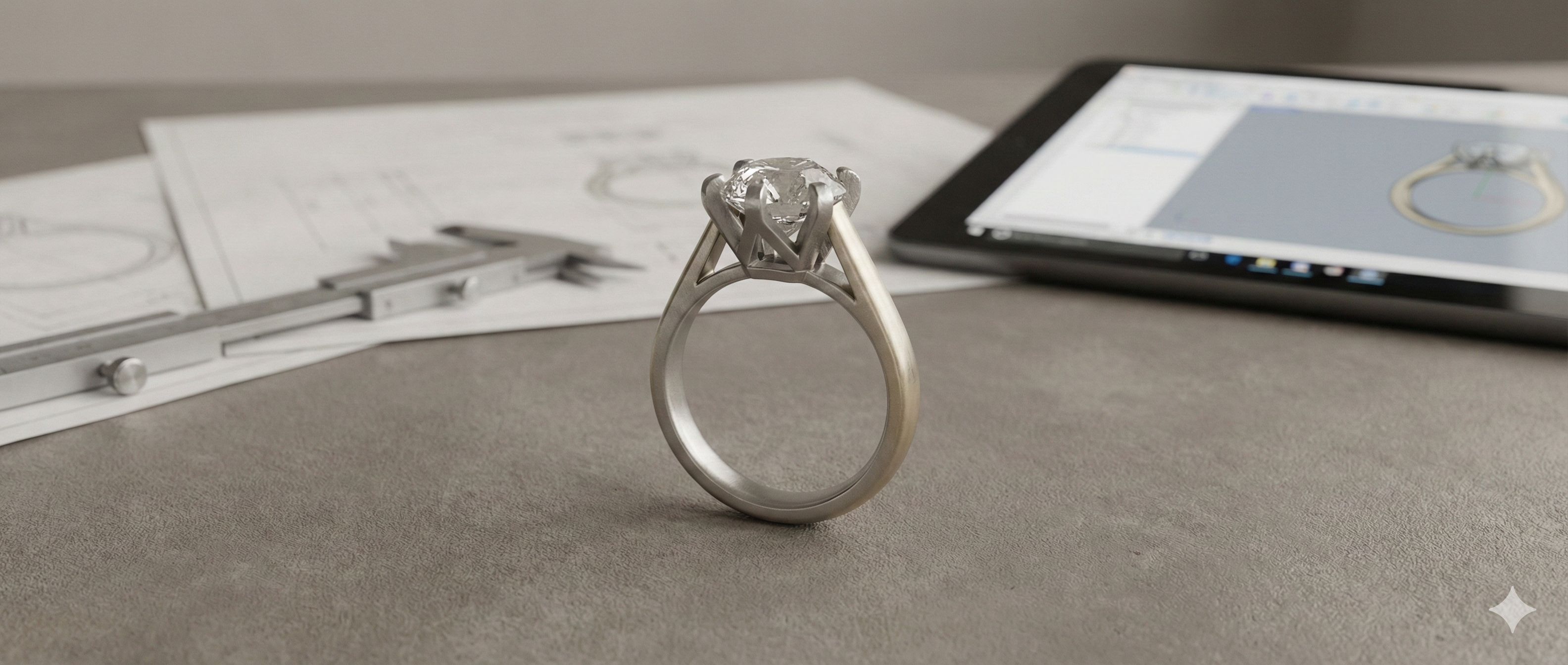
In a true bespoke workflow, CAD design, 3D printing, casting, and finishing are all aligned to the final approved structure. Nothing is “adjusted later” to make it work. This reduces compromises, improves stone security, and ensures the finished ring matches the design intent exactly.
What Does Not Change — Even When a Ring Is Bespoke
1. Physics Still Applies
Bespoke does not mean impossible. Ultra-thin bands, excessively high settings, or minimal claws will always compromise durability — regardless of craftsmanship. A proper bespoke consultation includes saying no when a design choice undermines structural integrity.
2. Precious Metals Have Fixed Limits
Platinum, 18K gold, and other precious metals behave in predictable ways. Bespoke does not change tensile strength, wear resistance, or long-term deformation properties. The difference is that a bespoke ring is designed with these limits in mind, rather than ignoring them for aesthetics.
3. Timelines Are Still Defined by Process
A bespoke ring takes time because each step depends on the one before it. Design approval, stone confirmation, printing, casting, setting, and finishing follow a fixed sequence. Anyone promising “instant bespoke” is not doing true ground-up design.
4. Cost Is Driven by Work, Not the Word “Bespoke”
Bespoke does not automatically mean expensive. Cost is determined by diamond quality, metal choice, and the complexity of engineering and finishing. In many cases, a structurally bespoke ring offers better value than a heavily marked-up branded setting.
Why This Distinction Filters Serious Buyers
True bespoke appeals to buyers who value decision-making over decoration. If you want instant answers, catalogue browsing, or trend-driven designs, bespoke will feel slow and overly detailed. If you care about why a ring is built a certain way — and how that affects daily wear for decades — bespoke becomes the only logical option.
This is why proper consultations matter. They are not about upselling. They are about aligning expectations with reality before any design work begins.
How Diamond Ateliers Approaches True Bespoke
At Diamond Ateliers, every bespoke engagement ring starts with education, not sketches. Clients are guided through diamond selection, structural design principles, and real-world wear considerations before a single CAD line is drawn. Our in-house design team produces and reviews every ring internally, with full transparency on pricing, trade-offs, and design decisions.
This approach consistently results in rings that are balanced, durable, and visually timeless — not because they follow trends, but because they are engineered correctly from the start.
Is Bespoke Right for You?
Bespoke is not for everyone — and that is exactly the point. If you want a ring that is structurally sound, proportionally correct, and designed specifically for one wearer and one stone, bespoke is worth the process. If you want speed, minimal involvement, or aesthetic-first decisions, a preset ring may be a better fit.
The value of a true bespoke consultation lies in clarity. You leave knowing whether bespoke makes sense for you — before committing time or money.
Speak With the Founders
If you want to understand what a truly bespoke engagement ring involves — and whether it aligns with your priorities — book a consultation with Diamond Ateliers. We design and produce 80–100 bespoke rings monthly in Singapore, with every decision explained clearly and honestly. No pressure, no catalogue shortcuts, just structural truth.
— Diamond Ateliers, Singapore