Oval Cut Engagement Rings in Singapore: The Complete Guide
Why Oval Cuts Are Everywhere Right Now
Oval cut engagement rings have had a sustained rise over the past five years and show no signs of slowing. They now sit alongside round brilliants as one of the most-requested shapes we work with, and for good reason: the oval delivers on almost every front that matters in an engagement ring.
It faces up larger than a round brilliant of equivalent carat weight. It flatters the finger with its elongated shape. It carries the brilliance of a round cut. And it offers enough design flexibility to work beautifully in everything from a simple solitaire to a detailed vintage setting.
But ovals have more nuance than most shapes, and getting one wrong — wrong proportions, wrong setting, wrong length-to-width ratio — produces a ring that looks awkward or dull rather than striking. Here’s what to understand before you buy.
The Bow-Tie Effect: What It Is and Why It Matters
The bow-tie is the most important concept to understand when buying an oval cut diamond. It refers to a dark shadow in the shape of a bow-tie that appears across the centre of an oval when light is not being returned efficiently from those facets.
Almost all oval diamonds have some degree of bow-tie — the question is how pronounced it is. A faint bow-tie that disappears in most lighting conditions is acceptable and may not be visible in a set ring. A strong bow-tie creates a dark horizontal band across the centre of the stone that is visible from across the table. These stones should be avoided regardless of their certificate grade.
Critically, the bow-tie does not appear on a GIA certificate. It cannot be detected by reading numbers. You must look at the specific stone — either in person or via a detailed video that shows the stone moving through different lighting conditions. This is one area where buying an oval sight-unseen is genuinely risky.
The degree of bow-tie is primarily a function of how the stone is cut: its length-to-width ratio, its table percentage, and how the facets at the centre are proportioned. Well-cut ovals from reputable cutters minimise the effect without sacrificing brilliance elsewhere.
Length-to-Width Ratio: Finding the Right Shape for the Finger
Oval diamonds are described by their length-to-width (L/W) ratio, which determines how elongated or rounded the stone appears. A ratio of 1.00 would be a perfect circle. Most ovals fall between 1.30 and 1.70.
A ratio around 1.30–1.40 gives a rounder oval — still clearly not round, but not dramatically elongated. These can look substantial and full.
A ratio around 1.45–1.55 is the classic elongated oval that most people picture when they think of the shape. This range is broadly flattering on most finger shapes and sizes.
A ratio of 1.60 and above produces a very elongated stone that maximises the finger-lengthening effect but can look narrow and less substantial face-up. These work well on wider fingers and in east-west settings.
The right ratio depends on the wearer’s hand and personal preference. If you can, look at the stone on the finger before committing. What reads as elegant proportions in isolation can look different against a specific finger width and length.
How Much Larger Does an Oval Look vs a Round Brilliant?
This is one of the main reasons people choose ovals: they appear larger than round brilliants of the same carat weight.
A 1.00ct round brilliant has a diameter of approximately 6.4–6.5mm. A 1.00ct oval with a 1.50 ratio measures roughly 7.7 × 5.2mm — covering noticeably more finger area. Because the oval is elongated, it looks larger from above even though it weighs the same.
The practical implication: a 1.00ct oval will often look comparable in face-up size to a 1.20ct round brilliant. If visual size matters — and for many people it does — this is meaningful value.
The tradeoff: ovals carry more weight in their depth than rounds, so the depth percentage tends to be higher. A shallow-cut oval will show more face-up size but may compromise brilliance. A well-cut oval balances face-up area with light return.
Settings That Work Best with Oval Diamonds
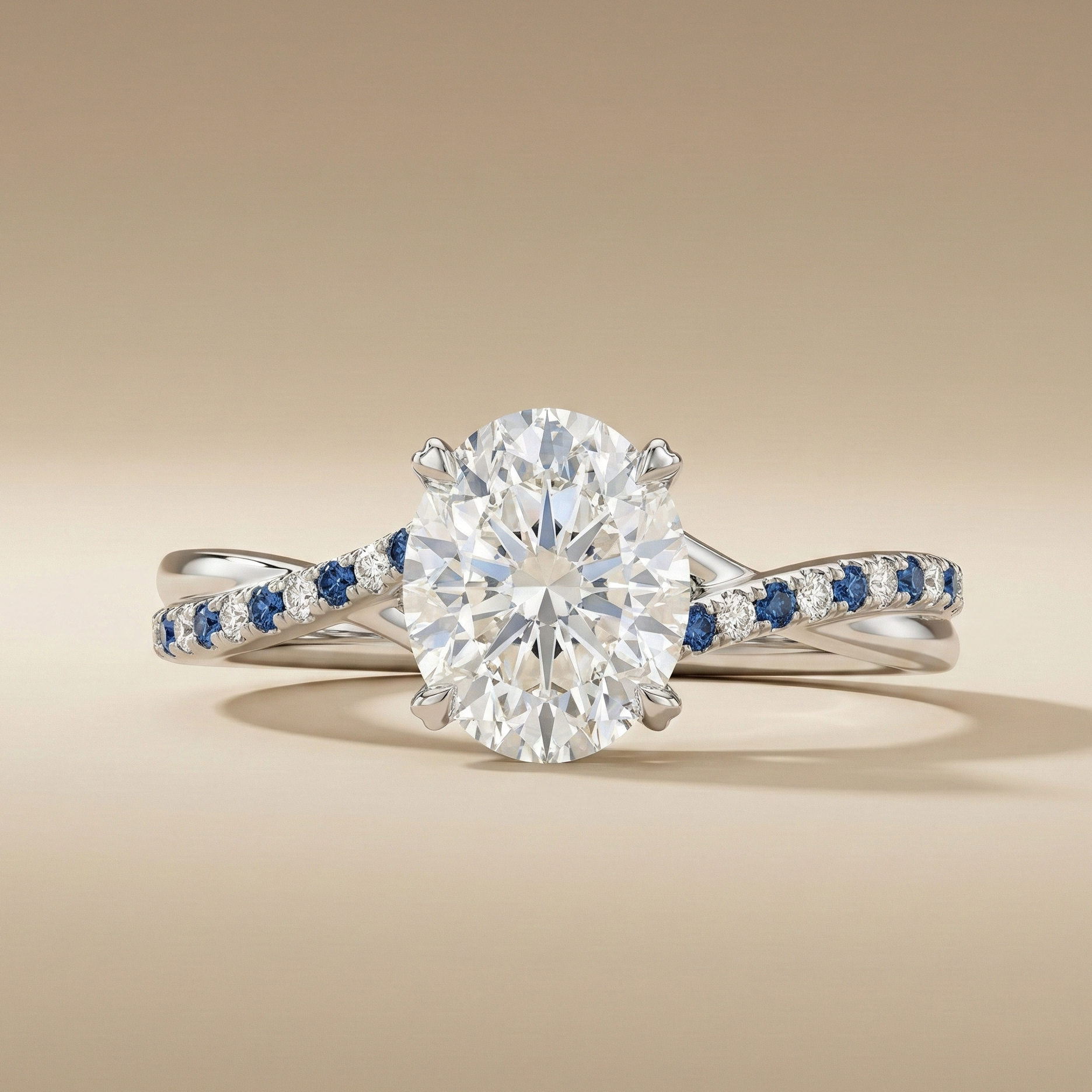
Solitaire (four or six claw)
The simplest setting and often the most elegant for ovals. Four claws placed at the tips of the oval — two at each end — hold the stone securely while maximising light entry. Six claws add two side claws and provide additional security for a larger stone. The key with ovals in solitaires: make sure the claws are V-tipped rather than round-tipped at the pointed ends of the stone, which protects the edges without adding visual bulk.
Hidden halo
A halo of small pavé diamonds set below the main stone, visible only from the side, creates the appearance of a floating centre stone from above while adding sparkle when the hand moves. This is a cleaner look than a traditional surround halo and works particularly well with ovals because it doesn’t interrupt the elongated silhouette.
Pavé band
A plain solitaire setting with a pavé diamond band is a versatile combination that lets the centre stone remain the focus while adding brilliance to the ring overall. For ovals, a slightly tapered pavé band — narrower toward the setting, wider at the back — complements the shape without competing with it.
East-west setting
Setting the oval horizontally across the finger rather than vertically is a design choice that reads as more contemporary and architectural. It works particularly well with high-ratio ovals (1.60+) and in bezel or half-bezel settings. Less common than vertical orientation, which makes it a distinctive option.
Three-stone
An oval centre flanked by two smaller stones — rounds, half-moons, or tapered baguettes — creates a classic silhouette with strong symbolic meaning. The side stone proportions matter significantly here: stones that are too large crowd the centre, while stones that are too small look imbalanced.
Colour and Clarity for Oval Diamonds
Oval diamonds show colour more readily than round brilliants because their large, open facet pattern doesn’t break up light the same way. For white gold or platinum settings, we recommend H colour or above for ovals. G colour is the safe choice if budget allows. In yellow or rose gold, I colour is typically fine and will appear white in context.
For clarity, VS2 is a reliable choice. Many VS2 ovals are eye-clean. SI1 can work but requires reviewing the specific stone — inclusions near the centre of an oval are more visible than inclusions toward the edges or under the claws.
Oval Cuts in a Custom Setting
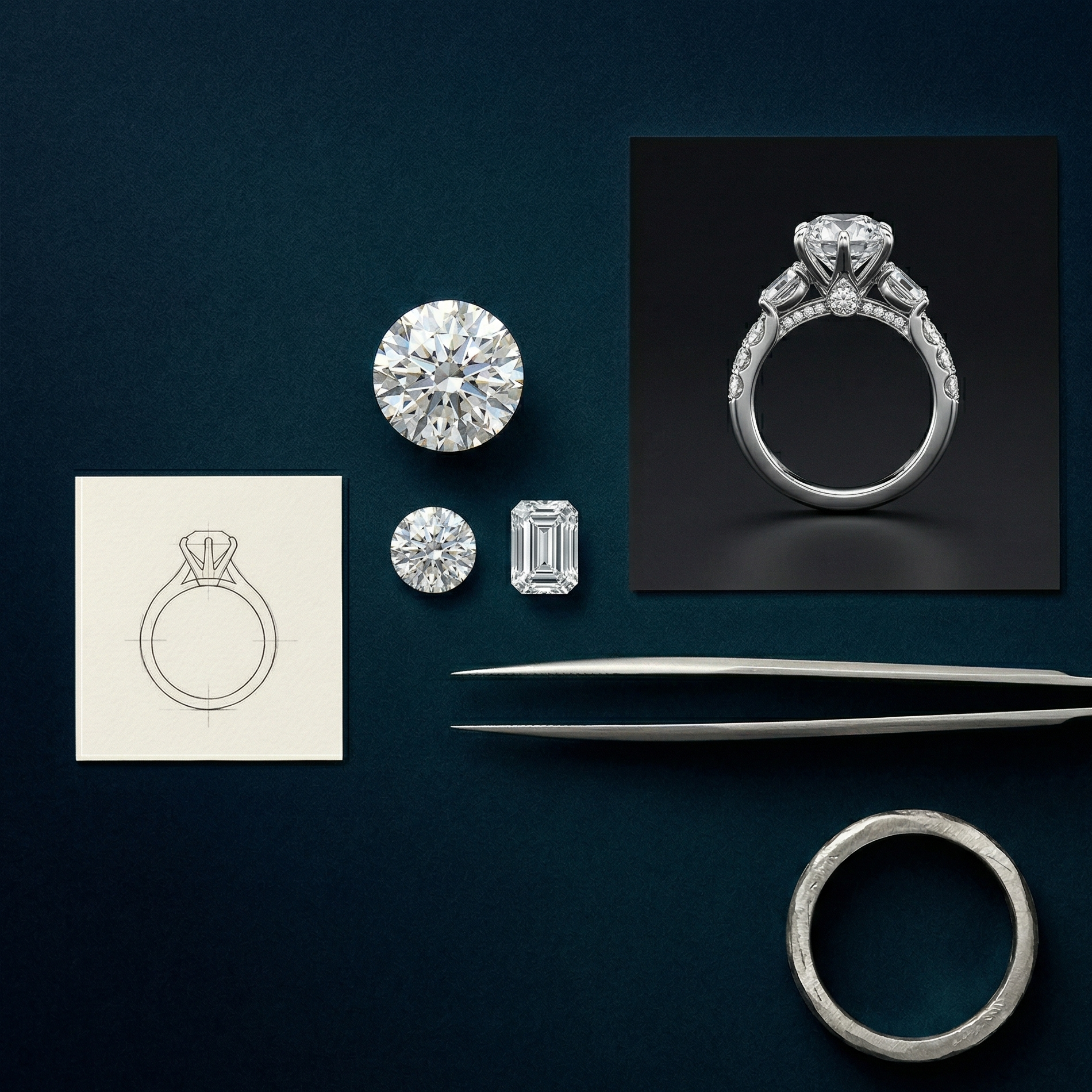
Oval diamonds work exceptionally well in bespoke settings because the shape offers so much flexibility in how the stone is presented. The elongated form can be emphasised or softened depending on the setting design. The bow-tie — if present and slight — can often be minimised visually through claw placement and setting profile.
When we work with a client on an oval engagement ring, we start with the specific stone rather than a setting template, then design the setting to suit those exact dimensions and how the stone performs in light. This produces a better result than choosing a setting first and fitting a stone to it.
If you have a specific oval in mind, or want to understand what’s available at your budget, we’re happy to advise.
Message us on WhatsApp to start the conversation, or book a consultation to see oval stones in person.