Engagement Ring Trends Singapore 2026 (What Actually Lasts)
Every year, “engagement ring trends” get louder. But as a Singapore bespoke studio designing 80–100 rings monthly, we see something different: most trends don’t age well. What lasts is proportion, structure, and personal intent. As we move into 2026, couples are becoming sharper. They are no longer asking, “What’s trending?” They’re asking, “Will I still love this in 10 years?”
This isn’t a trend-chasing article. This is a founder’s prediction based on real design data from the studio floor: the oversaturation of oval engagement rings in Singapore, the hidden halo plateau, and the rise (and risk) of chunky bands. If you’re designing a ring this year, here’s what will actually endure.
Oval Engagement Ring Singapore: Oversaturated, But Not Dead
Ovals dominated 2023–2025. Social media amplified them. Influencers standardised them. Suddenly, everyone had a 1.5–2.5ct oval on a thin band.
But oversaturation creates fatigue.
The problem isn’t the oval shape itself. It’s proportion.
An oval works when:
- The length-to-width ratio suits the wearer’s finger.
- The setting supports the elongated silhouette.
- The band thickness is structurally balanced.
An oval fails when:
- It’s chosen purely for size illusion.
- It sits on a 1.5mm band for “daintiness.”
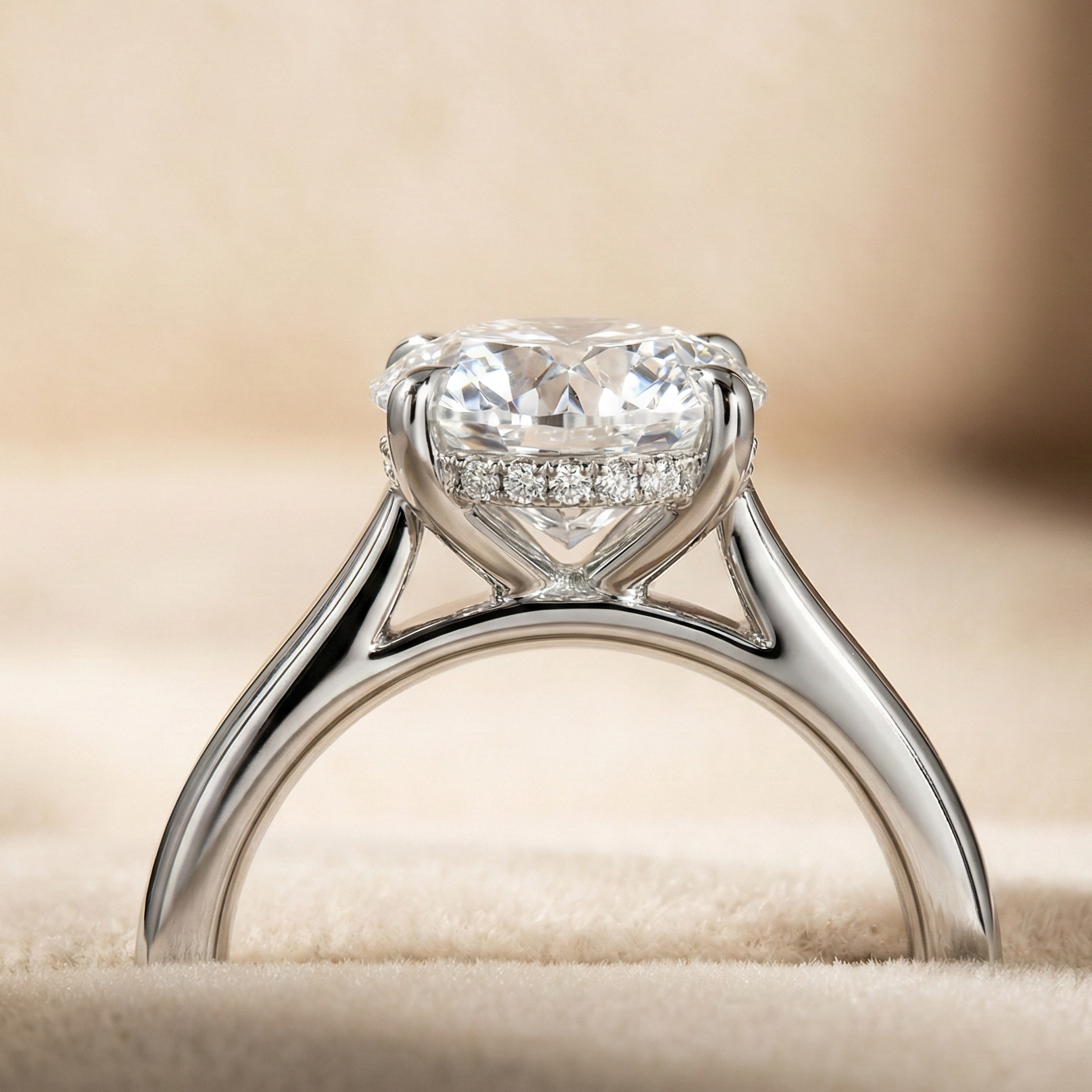
- The hidden halo is used to artificially boost spread.
In 2026, we predict a correction: fewer generic ovals, more proportion-conscious ovals.
At Diamond Ateliers, when we design oval engagement rings in Singapore, we often adjust band width upward slightly and refine the claw structure so the stone doesn’t feel like it’s floating on wire. That’s the difference between trendy and timeless.
If you’re choosing oval purely because it “looks bigger,” read our practical buyer breakdown here:
Lab vs Natural Diamonds: A Practical Buyer’s Guide for 2026
Hidden Halo Engagement Ring: The Plateau Phase
Hidden halos were exciting when they first appeared. Subtle sparkle from the side. A secret detail only the wearer sees.
But by 2025, they became default.
Now in 2026, we’re seeing three things:
- Clients don’t realise maintenance increases.
- Many hidden halos are too thick, lifting the centre stone awkwardly.
- Some designs look dated because proportions weren’t considered.
A hidden halo engagement ring works when:
- The centre stone is high enough to justify side detail.
- The halo is micro-set, not bulky.
- The gallery structure remains clean.
It doesn’t work when:
- It’s added as decoration without structural logic.
- The band is too thin to support the extra height.
We’re designing fewer exaggerated hidden halos in 2026. Instead, we’re seeing refined galleries — architectural under-structures that look intentional, not ornamental.
For clients debating between visual drama and clean structure, this design framing helps:
What Makes a Ring Look Expensive (Even at the Same Budget)
Chunky Bands: The Rise of Substance
Here’s the real shift.
Chunkier bands are coming back.
Not 1990s heavy. Not costume.
But 2.2mm–2.8mm bands with weight.
Why?
- Durability
- Visual presence
- Balance with larger lab grown diamonds
Singapore buyers are more educated now. They understand value allocation. Instead of stretching budget on maximum carat, they’re choosing better structural design.
We discuss smart allocation in detail here:
Engagement Ring Price Guide
Here’s the key prediction:
Chunky bands will last — if the centre stone proportion matches.
A 3ct oval on a 1.6mm band looks temporary.
A 2ct oval on a 2.4mm band looks intentional.
Design maturity is replacing trend mimicry.
2026 Is the Year of Structural Awareness
If 2025 was about aesthetics, 2026 will be about engineering.
Couples are asking:
- Will this bend?
- Will this sit flush with a wedding band?
- Can I resize this later?
- Will I get tired of this silhouette?
This is why bespoke matters.
When a ring is truly custom, proportions are calculated from scratch — finger size, stone spread, setting height, band thickness. Not copied from a Pinterest photo.
If you’re unsure how bespoke actually differs from mass-produced settings, this explains the shift clearly:
Bespoke Engagement Rings
And for context on how trends evolved into this moment, see 2025’s overview:
Top Bespoke Engagement Ring Trends in Singapore 2025
Singapore Price Context (Indicative, Not Absolute)
In 2026 Singapore:
- 1.5–2ct lab grown centre stones remain a common sweet spot.
- Most bespoke rings fall into a mid four-figure to low five-figure SGD range depending on stone specs and design complexity.
- Chunkier bands slightly increase gold weight cost, but not dramatically compared to total diamond allocation.
The smarter question isn’t “What’s trending?” It’s “Where does my budget create long-term value?”
A ring worn daily for decades should prioritise:
- Proportion
- Structure
- Comfort
- Stone quality
- Setting integrity
Not social media duplication.
Founder Prediction: What Actually Lasts
In five years, here’s what we believe will still look right:
- Proportionally balanced ovals
- Clean, refined galleries (not exaggerated hidden halos)
- Substantial bands that frame the stone
- Designs created for the wearer — not the algorithm
What will feel dated?
- Ultra-thin bands under 1.6mm
- Overbuilt hidden halos
- Trend-driven shapes without finger consideration
Timelessness isn’t minimalism. It’s intentional design.
If You’re Designing in 2026
Don’t ask what’s viral.
Ask what fits your hand, your lifestyle, and your long-term taste.
At Diamond Ateliers, we design 80–100 bespoke rings monthly in Singapore. Every ring begins with proportion mapping, not trend boards. If you want guidance rooted in experience — not sales scripts — book a consultation and let’s design something that still feels right in 2036.
Browse inspiration here:
Engagement Rings Collection
Or start with our bespoke process:
Diamond Ateliers