Emerald Cut Engagement Rings in Singapore: The Complete Buying Guide
Emerald cut engagement rings have been quietly gaining ground in Singapore over the last few years — and once you understand what makes them different, it's easy to see why.
They don't try to dazzle you the way a round brilliant does. Instead, they draw you in. The long, open facets catch light in a slower, more deliberate way — flashes rather than sparkle, depth rather than fireworks. For the right person, that's exactly the point.
This guide covers everything you need to know before buying or commissioning an emerald cut engagement ring in Singapore: what makes the cut work, where most buyers go wrong, and how to make sure you end up with a stone you'll still love in twenty years.
What Actually Makes an Emerald Cut Different
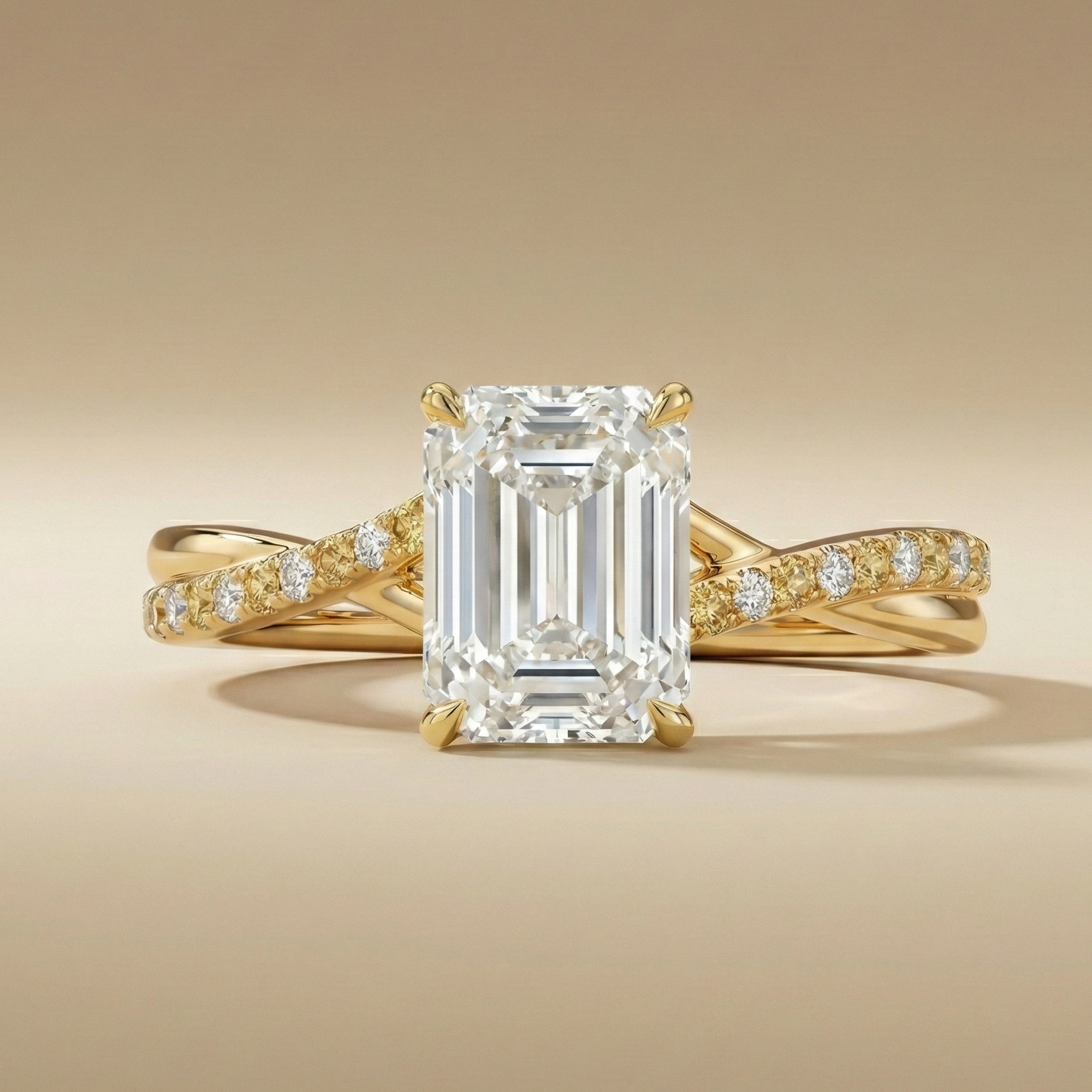
Most popular diamond shapes — round, oval, pear, cushion — are brilliant cuts. They're designed with a large number of small, angled facets that maximise light return and sparkle. An emerald cut is a step cut. It has long, rectangular facets arranged in parallel steps, like the inside of a hall of mirrors.
The result is a completely different visual effect. Where a brilliant cut scatters light into hundreds of tiny flashes, an emerald cut produces broad, sweeping reflections — what gemologists call the "hall of mirrors" effect. It's elegant, architectural, and unmistakably calm.
That calmness is what many buyers love about it. It's also what makes it unforgiving: because the facets are open and transparent, there's nowhere for inclusions or poor colour to hide.
Clarity Matters More Than You Think
This is where most first-time buyers are caught off guard. With a round brilliant cut, a VS2 or even SI1 clarity grade looks eye-clean in almost every case — the brilliant faceting masks inclusions effectively. With an emerald cut, inclusions sitting in the centre of the stone are often clearly visible to the naked eye at SI1 and sometimes even VS2.
As a general rule for emerald cuts in Singapore, we recommend:
- VS1 or better if you want to be confident of an eye-clean stone without inspecting it first
- VS2 can be eye-clean — but you need to view the specific stone before buying
- SI1 and below is a risk we'd advise against for emerald cuts unless you've seen the stone in person and are comfortable with what's visible
This applies to both natural and lab-grown diamonds. Lab-grown emerald cuts are increasingly available in Singapore at significantly lower prices, which allows many couples to move up in clarity without stretching the budget.
Colour Shows More Too
For the same reason, colour is more visible in an emerald cut than in a brilliant cut. The open facets let you look deeper into the stone, which means any warmth in the body colour is easier to detect.
If you're setting the diamond in platinum or white gold, we'd generally suggest staying at H colour or above for an emerald cut. G or F gives you a noticeably crisp, white appearance. I and J can look warm against a white metal setting — some people like that, but it's worth knowing before you commit.
If you're setting in yellow or rose gold, you have more flexibility — the warm tones of the metal complement a slightly warmer stone, and J or even K colour can look beautiful in the right design.
Length-to-Width Ratio: The Detail Most People Miss
Emerald cuts vary considerably in their proportions. A square emerald cut (technically called an Asscher cut if it has cropped corners) looks very different from a long, narrow emerald cut. The ratio that describes this is the length-to-width ratio.
- 1.30-1.40 is the classic emerald cut proportion — elongated but not extreme, works on most finger types
- 1.40-1.50 is noticeably longer and sleeker — flattering on wider fingers, can look narrow on slender ones
- Below 1.30 starts to look closer to a square — a distinctive look, more unusual
There's no objectively correct ratio. But when clients come to us unsure, we usually start around 1.35 and go from there based on hand proportion and preference. If you're buying online without seeing the stone, this is one of the numbers worth paying attention to.
Settings That Work Well With Emerald Cuts
The elongated, geometric shape of an emerald cut suits certain settings better than others.
Four-claw solitaire — The most classic choice. Four claws at the corners let the stone breathe and show off its shape without distraction. Simple, timeless, and almost impossible to get wrong.
East-west solitaire — Rotating the stone 90 degrees so it sits horizontally across the finger gives the ring a modern, architectural look. It's less common, which makes it distinctive. Works especially well with longer ratios.
Pave band — A thin pave band flanking an emerald cut solitaire adds presence without competing. The contrast between the stone's clean geometry and the sparkle of the side stones reads well in person. Keep the band narrow — a chunky pave band can overwhelm the stone.
Three-stone — An emerald cut flanked by two tapered baguettes is one of the most sophisticated combinations in jewellery. The parallel step-cut facets of the baguettes echo the main stone, creating a cohesive, art deco sensibility. If you want something with presence, this is worth considering.
Bezel setting — A full bezel gives the ring a sleek, minimal look and protects the stone's edges, which on an emerald cut are its most vulnerable points. Suits a contemporary aesthetic well.
Emerald Cut vs Asscher Cut
If you're drawn to step cuts, you'll likely encounter both. The key differences:
An emerald cut is rectangular with cropped corners. An Asscher cut is square with more deeply cropped corners, giving it an almost octagonal outline. The Asscher has a distinctive square "X" pattern visible when you look straight down into the stone — a result of its deeper pavilion and more dramatic step arrangement.
Both are beautiful. Emerald cuts tend to read as more elongated and elegant; Asschers tend to read as more bold and geometric. If you like the idea of a step cut but aren't sure which direction to go, it's worth looking at examples of both on a hand — they feel quite different in person.
What to Expect to Pay in Singapore
Emerald cuts are generally priced slightly lower than round brilliants of comparable carat weight, because less rough diamond is lost in the cutting process. In Singapore, a 1 carat natural emerald cut at VS1, G colour typically starts from around SGD 8,000-12,000 for the stone alone, depending on the source and certificate. The ring setting itself adds to this.
Lab-grown emerald cuts at the same specifications cost considerably less — typically 60-75% lower — and the quality of the cutting has improved significantly in recent years. For many couples commissioning bespoke rings in Singapore, a lab-grown emerald cut allows them to go larger or cleaner within the same budget.
If you're working to a specific number, it's worth having an honest conversation about what's achievable at your price point before you fall in love with a specific size. We'd rather tell you the truth early than let you set expectations you'll have to revise later.
Commissioning a Bespoke Emerald Cut Ring in Singapore
Emerald cuts are well-suited to bespoke work because their geometry gives designers clear lines to work with. Whether you want a minimal four-claw solitaire on a plain platinum band or a three-stone with tapered baguettes and a pave wrap, the design process is usually straightforward.
At Diamond Ateliers, we work with you to select the stone first — reviewing cut quality, clarity, colour, and proportions before anything is made — and then design the setting around it. Most bespoke emerald cut rings at our Singapore showroom take four to six weeks from design sign-off to collection.
If you have questions before booking, WhatsApp us — most clients do that first, and we're happy to answer without any obligation.
Or, if you're ready to come in, book a free consultation at our showroom at The Centrepoint, Orchard Road.