7 Engagement Ring Details Most People Miss
Diamond Ateliers · Singapore · Bespoke Engagement Rings
7 Engagement Ring Details
Most People Miss
But Jewellers Always Notice
When most people begin shopping for an engagement ring, their attention goes straight to the diamond — its shape, carat size, and how it sparkles under the light. These are, of course, important.
But ask any experienced jeweller what separates a truly beautiful ring from a merely acceptable one, and the answer is rarely about the stone alone.
The details matter enormously. The way the prongs are shaped. How the band narrows toward the centre. Whether there is a delicate ring of diamonds hidden just below the setting. These are the engagement ring details that influence how a ring catches the light, how comfortable it feels after ten years of daily wear, and whether it looks handcrafted or mass-produced.
At Diamond Ateliers, our bespoke engagement rings in Singapore are designed with every one of these elements in mind. This guide walks you through seven engagement ring design details that most customers never think to ask about — but that our jewellers consider essential.
The small details are what separate a ring made for someone from a ring made for anyone.
Petal Prongs
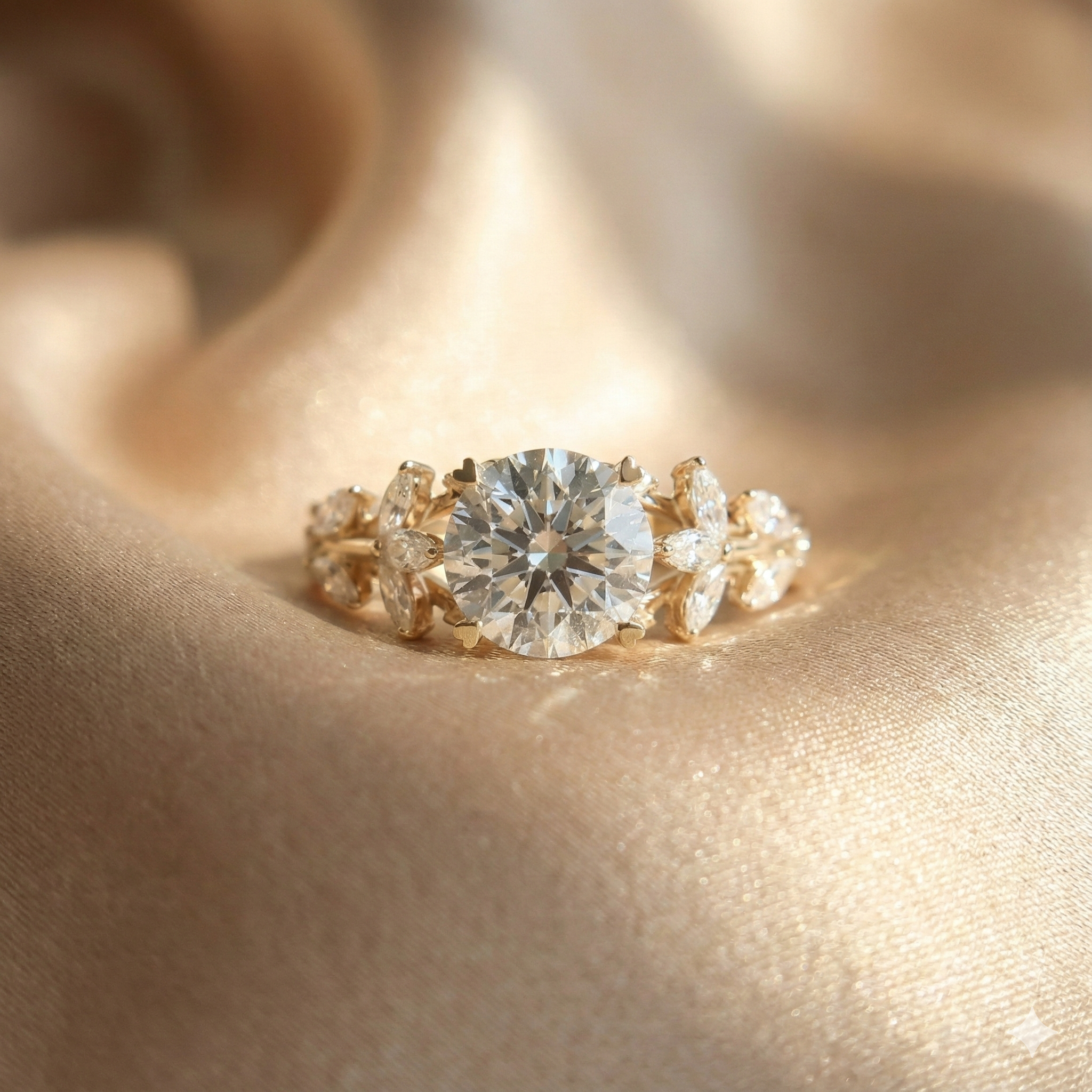
Most engagement rings use standard claw or round prongs to hold the diamond in place. Petal prongs are a refined alternative — shaped so that when viewed from the side, each prong fans outward in a soft, curved form that resembles the petals of a flower.
This is far more than decorative. Where standard prongs can look blunt or mechanical against a fine diamond, petal prongs create a visual softness that frames the stone beautifully. They make the diamond appear more delicate, more elevated — as if it is cradled rather than simply held.
For solitaire rings, this detail transforms the entire profile. Instead of sharp, abrupt tips interrupting your view of the stone, the prongs become part of the ring's visual story. Petal prongs are particularly well-suited to oval and round cut diamonds, where their curved form echoes and enhances the soft contours of the stone itself.
It is a small detail. But it is one of the first things a jeweller notices — and one of the most effective ways to elevate a classic solitaire design.
Hidden Halo
A traditional halo is a visible ring of smaller diamonds surrounding the centre stone, designed to amplify its apparent size and add brilliance. A hidden halo engagement ring works differently — and that is precisely what makes it special.
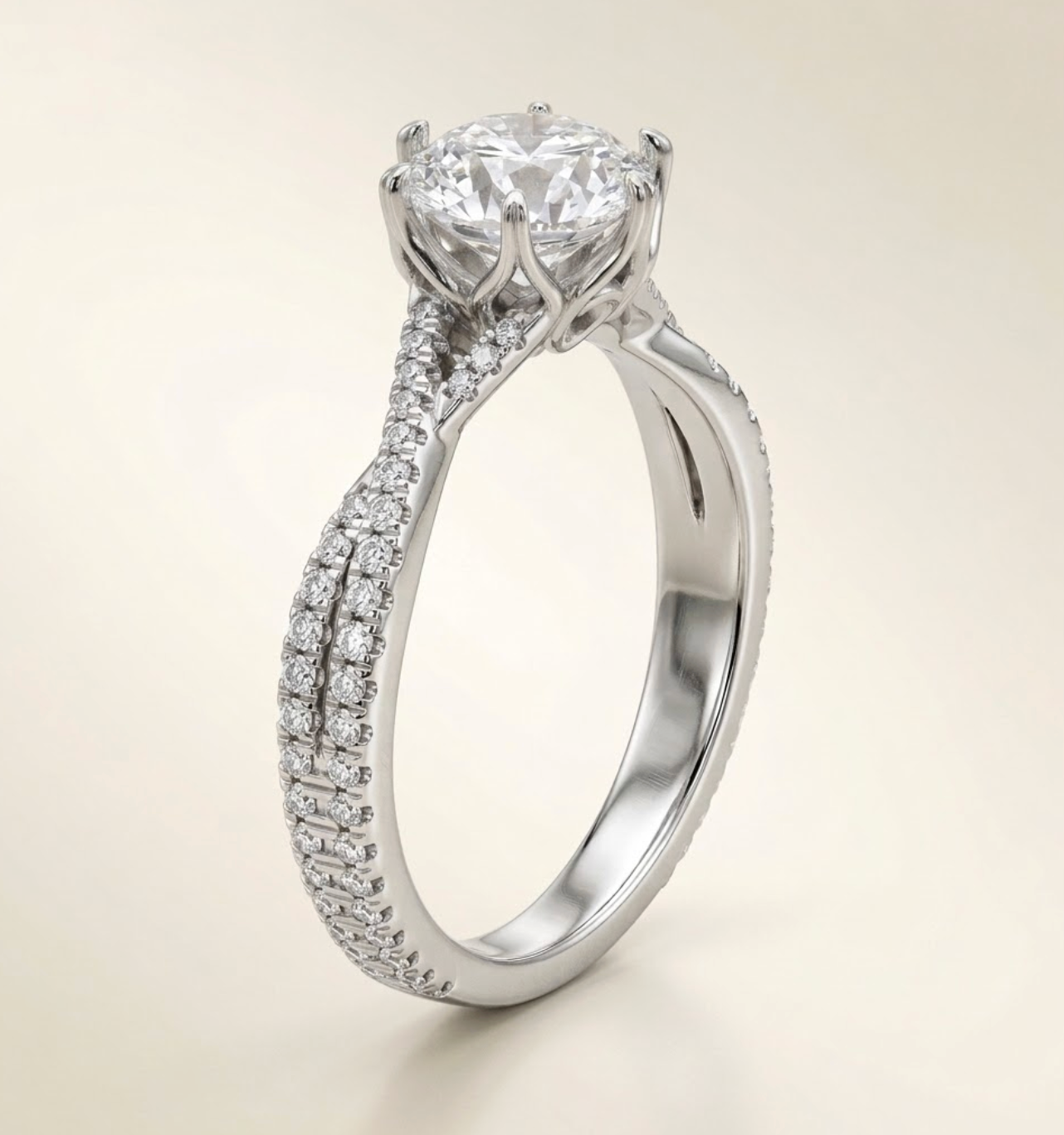
Tucked just beneath the bezel of the centre setting, a hidden halo is invisible when you look at the ring from above. Instead, it reveals itself when the ring is viewed from the side or at an angle — a discreet ring of pavé diamonds that catches the light in a way that feels almost like a surprise.
The effect is distinctly modern. The ring appears clean and architectural from the top, yet radiates additional sparkle from every other angle. For couples who want understated elegance on the surface with a hidden layer of brilliance, the hidden halo has become one of the most sought-after features in contemporary bespoke design.
This feature works exceptionally well with oval, cushion, and radiant cut diamonds, where the soft geometry of the stone pairs naturally with the curved form of the halo beneath.
Cathedral Shoulders
The term "cathedral engagement ring" refers to a setting style where the band curves upward in graceful arches on either side of the centre stone, much like the soaring buttresses of a Gothic cathedral. It is one of the most architecturally inspired engagement ring design details — and one of the most structurally intelligent.
By gradually raising the shank toward the centre setting, cathedral shoulders distribute the physical stress of daily wear more effectively than a flat band. This means the prongs and setting receive better structural support over time — an important consideration for a ring worn every day for decades.
Aesthetically, the effect is unmistakable. The rising shoulders give the diamond greater height and presence, making it appear more regal and prominent on the finger. The upward sweep creates a silhouette that feels timeless — substantial without being heavy, grand without being ostentatious.
Cathedral shoulders are a detail that photographs exceptionally well and ages beautifully — which is exactly what you want from a ring worn for a lifetime.
Band Thickness
Ask most people what they notice about an engagement ring and band thickness will not appear on their list. Ask a jeweller, and it will be one of the first things they mention.
The thickness of the band — measured in millimetres — directly affects comfort, durability, and visual balance. A band that is too thin may feel delicate initially, but will be more susceptible to bending or warping with daily wear. A band that is too thick can feel cumbersome and visually overpower a more refined centre stone.
For most engagement rings, a band thickness between 1.6mm and 2.2mm provides the right balance. Bands around 1.6mm to 1.8mm suit finer, more delicate designs — particularly those with smaller stones or slim pavé detailing. Bands of 2.0mm to 2.2mm are better suited to larger centre stones and more substantial settings, providing the visual weight needed to create proportion.
This is also a practical comfort question. A well-fitted band with appropriate thickness should sit snugly on the finger without creating pressure — something that only becomes apparent over years of wear. In bespoke engagement ring design, getting the band thickness right is not optional. It is foundational.
Tapered Shank
A tapered shank is a design feature where the band gradually narrows as it approaches the centre stone, then widens at the back to maintain comfort around the finger. This subtle narrowing creates one of the most elegant optical effects in engagement ring design: it makes the centre diamond appear considerably larger than it is.
The logic is simple. When the band is thinner at the point where it meets the setting, the eye is drawn to the diamond rather than the metal surrounding it. The stone becomes the uncontested focal point, its perceived size amplified by contrast against the narrowing band.
Beyond the visual effect, a tapered shank lends the ring a refined, elongated quality that reads as unmistakably high-end. It is a common detail in fine bespoke engagement rings precisely because it demonstrates considered design thinking — a ring that has been crafted to flatter both the stone and the hand wearing it.
If you have ever looked at a ring and thought, "I cannot explain why, but it just looks more elegant" — a tapered shank is often the reason.
Diamond Height
How high the centre diamond sits above the band is a detail with significant consequences — for sparkle, comfort, and practicality.
A high-profile setting elevates the diamond well above the band, allowing maximum light to enter from all directions. This optimises brilliance and fire — the play of light that makes a diamond captivating. High-profile settings are also easier to clean, as light and air can circulate freely around the stone.
The trade-off is practicality. A diamond set high on the finger is more likely to snag on fabrics, bump against surfaces, or catch on hair. For someone who works with their hands regularly, this becomes a genuine consideration.
A low-profile setting keeps the diamond closer to the band — more secure, less likely to catch, and better suited to an active lifestyle. The compromise is a marginal reduction in the way light interacts with the stone, though modern bezel and low-set prong designs minimise this difference considerably.
At Diamond Ateliers, we discuss diamond height carefully with every client. The right answer depends on how the ring will be worn — and over a lifetime, that matters far more than any single design preference.
Personal Engravings
An engraving is the most intimate engagement ring detail of all — and among the most frequently overlooked until after the ring is made.
Traditionally placed on the inside of the band, engravings can take many forms: initials, a proposal date, a meaningful phrase, a private nickname, or even the coordinates of a significant place. Invisible to anyone but the person wearing it, an engraving transforms a piece of fine jewellery into something irreplaceable.
What most people do not realise is that engravings must be planned before the ring is finished — not added as an afterthought. The internal circumference of the band determines how many characters can comfortably fit, and the font style should complement the ring's overall aesthetic. A contemporary ring in clean lines calls for a different typeface than an intricate vintage-inspired design.
In a world where so many products are produced at scale, an engraving is the detail that ensures your ring exists nowhere else on earth. It belongs entirely to you.
The Details Are the Difference
A diamond is the centrepiece of every engagement ring. But the diamond alone does not determine whether a ring is truly beautiful. It is the engagement ring details surrounding it — the way the prongs are formed, the hidden sparkle beneath the setting, the architecture of the shoulders, the precision of the band — that determine whether a ring feels like it was made for someone in particular, or simply made.
These are the details that separate mass-produced jewellery from bespoke craftsmanship. They are the reason two rings with identical diamonds can look and feel entirely different. And they are the reason that understanding engagement ring design details — before you commission a ring — is one of the most valuable things you can do.
At Diamond Ateliers, every ring begins with a conversation about exactly these elements. Because when you are designing something to be worn for a lifetime, every detail deserves consideration.
Ready to Design Your Dream Engagement Ring?
Book a consultation with one of our expert jewellers and explore how small design details can transform a ring into something truly personal.
Book Your Consultation