
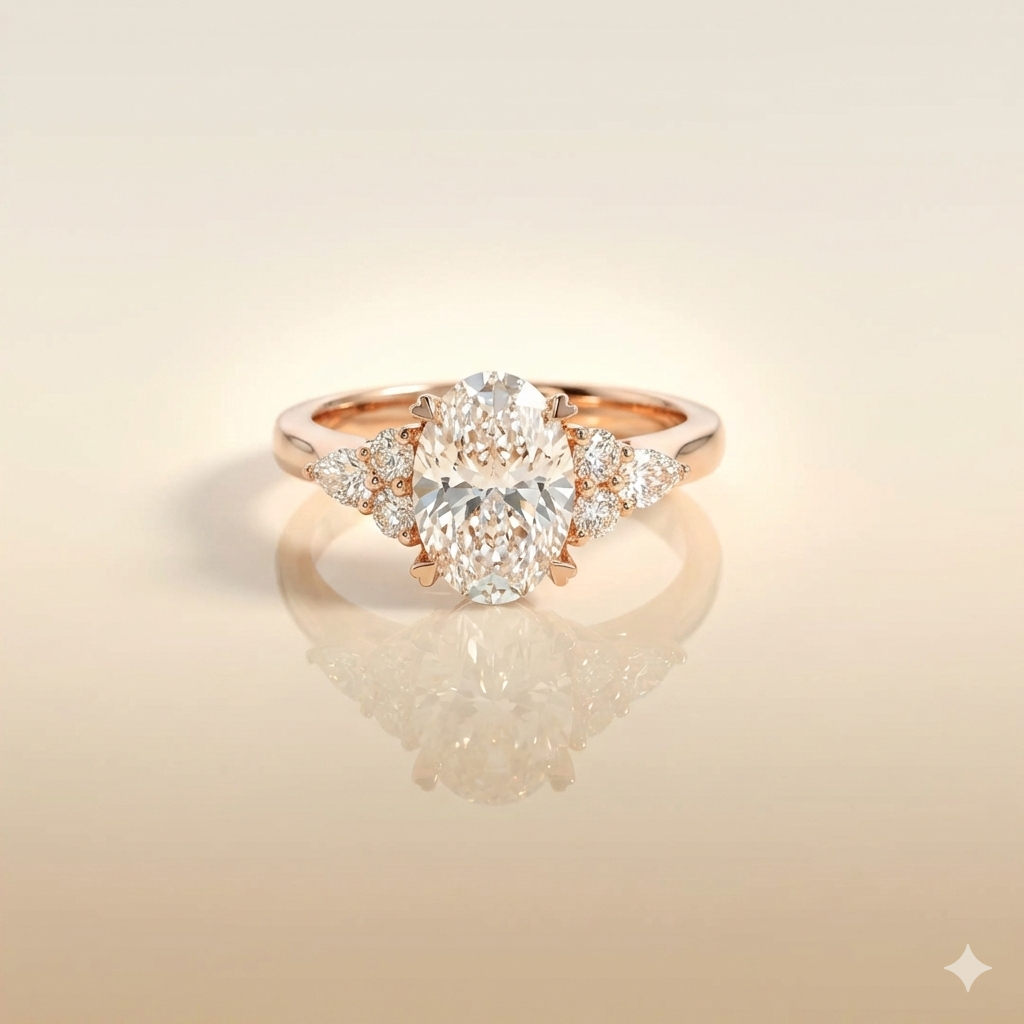
4 or 6 prongs for an oval diamond: how to decide (and when to use NSEW)
4 or 6 prongs for an oval diamond: how to decide (and when to use NSEW)
If you’re choosing an oval engagement ring in Singapore, the prong decision matters more than most people realise. With ovals, prongs don’t just “hold the diamond” — they also control how long the stone looks, how protected the tips are, and whether you’ll see that subtle oval “tilt” over years of daily wear. At Diamond Ateliers, we design and produce 80–100 bespoke engagement rings monthly, so we see the same question every week: 4 or 6 prongs? The right answer depends on three factors: your oval’s proportions (especially the tips), your lifestyle, and the look you want on the finger. This guide breaks down 4-prong vs 6-prong settings, explains NSEW prongs for oval diamonds, and gives practical selection rules you can use immediately.
Quick decision: 4 vs 6 prongs for an oval
Choose 4 prongs if you want the oval to look longer and cleaner
- Most diamond visible: fewer prongs means less metal on the outline.
- More “elongation”: a clean 4-prong layout emphasises the oval’s length.
- Modern solitaire feel: especially with fine claws or petite talons.
Trade-off: the oval’s tips are the vulnerable points. With only 4 contact points, prong placement and build quality matter a lot.
Choose 6 prongs if you prioritise durability and long-term tip protection
- More security: extra prongs reduce risk if one prong is knocked.
- Better tip control: especially helpful for thin tips or larger stones.
- More shape stability: less chance of the stone looking “off” over time.
Trade-off: slightly more metal presence. Done well, it still looks refined — but it will feel more “structured” than a minimal 4-prong.
Why ovals are different: the tips are everything
Round diamonds distribute stress evenly. Ovals don’t. An oval has two ends that take most of the impact from knocks. That’s why “4 vs 6 prongs” is not a style-only decision for an oval — it’s a structural one.
When we assess an oval for a bespoke setting, we look at:
- Tip thickness: some ovals have noticeably thinner ends.
- Carat size: bigger stones have more leverage against prongs.
- Length-to-width ratio: very elongated ovals behave differently visually and structurally.
- How you wear jewellery: office wear vs hands-on daily activity changes the risk profile.
NSEW prongs for oval diamonds: what it means (and when it’s smart)
NSEW stands for North, South, East, West — four prongs placed at the top, bottom, left, and right of the diamond (think “compass points”).
Option A: Classic NSEW (4-prong compass)
This places prongs at both tips and widest points. It creates symmetry and a clean outline, but relies on proper engineering at the tips.
Option B: NSEW look with reinforced structure
A clean 4-prong appearance with additional strength built into the seat and gallery — ideal for daily wear without visual clutter.
Option C: NSEW-inspired 6-prong (tip-focused)
Often uses additional protection at the tips, with side prongs stabilising the stone’s orientation. Ideal for thin-tip or larger ovals.
Selection guide: how to decide in 60 seconds
Step 1: Lifestyle
- Hands-on daily activity → lean 6 prongs.
- Mostly office wear → 4 prongs can be ideal.
Step 2: Size & proportions
- Under ~1.50ct: 4 prongs often work well.
- 1.50–2.50ct: depends on tips and lifestyle.
- Above ~2.50ct: 6 prongs usually safer.
Step 3: Visual preference
- Longer look → 4 prongs.
- Balanced look → 6 prongs.
Prong style matters as much as prong count
In a custom engagement ring, prong shape, seat depth, and finishing often matter more than the number alone.
Singapore price context
Prong count has minimal impact on price compared to diamond quality and overall ring architecture. For diamond fundamentals and performance considerations, see our diamond guide.
FAQs: oval diamond prongs & NSEW settings
Is 4 or 6 prongs better for an oval diamond?
It depends on size, tip thickness, and lifestyle. 4 prongs maximise elongation; 6 prongs prioritise durability.
Are NSEW prongs safe for daily wear?
Yes — when properly engineered. Reinforced seats are recommended for active lifestyles.
Do prongs affect how big an oval looks?
Yes. 4 prongs generally make an oval appear longer, while 6 prongs soften elongation. Understanding oval diamond proportions helps guide the decision.
What I’d recommend in the studio
I’d evaluate your oval’s measurements and how you actually wear jewellery, then design prongs that deliver the look you want while holding up over time.
Call to action: If you’re choosing between 4, 6, or NSEW prongs for an oval diamond, book a private consultation at our Singapore studio. We’ll design the setting around your oval’s exact proportions.
%0A%0AIf%20you%E2%80%99re%20choosing%20an%20oval%20engagement%20ring%20in%20Singapore,%20the%20prong%20decision%20matters%20more%20than%20most%20people%20realise.%20With%20oval...)